Use the reference image strictly as the identity anchor for the man. Preserve the exact facial structure, eyes, nose, lips, skin tone, age, and every recognizable feature visible through the helmet opening. Do not reinterpret his identity. His face must remain unmistakably the same real person.
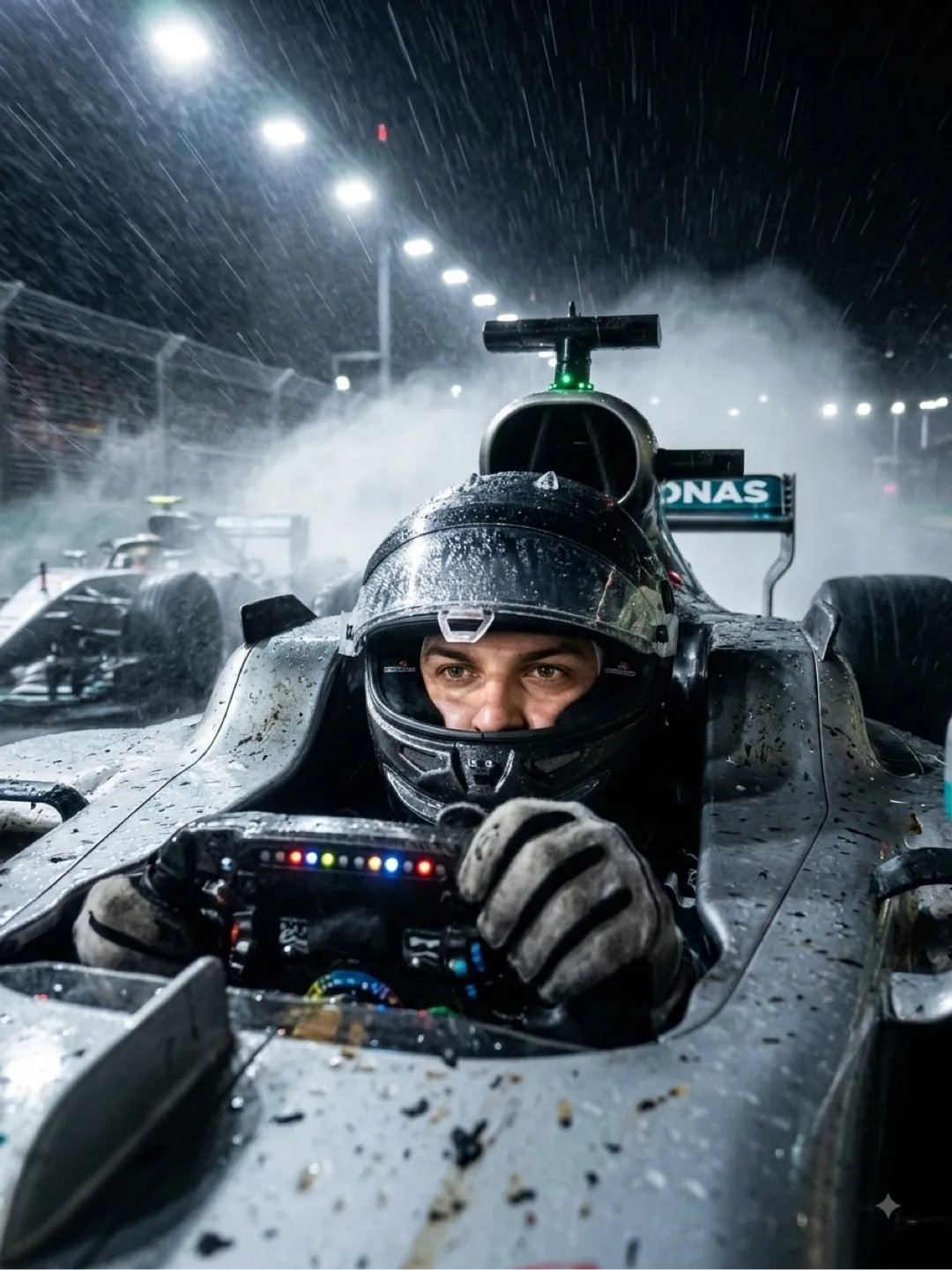
A cinematic ultra-realistic close action photograph of the man as an elite Formula racing driver fighting for position during a high-speed night race in heavy rain.
The camera is positioned extremely close alongside the cockpit from a realistic trackside telephoto perspective, capturing the car as it attacks a wet corner at racing speed while another single-seater runs almost wheel-to-wheel beside it.
The driver is fully strapped into the cockpit under intense physical load. His helmet moves subtly against the lateral G-force while both gloved hands grip the steering wheel with realistic tension.
Through the partially clear visor, his eyes and recognizable facial area remain critically sharp. His expression is intensely focused rather than aggressive — eyes looking far through the corner, brow naturally tense, jaw set, complete concentration.
Preserve his exact eye shape, facial proportions, skin tone, and recognizable identity behind the helmet. Do not generate a generic racing-driver face.
Rainwater beads and streaks across the visor. Tiny reflections from steering-wheel LEDs and track lighting move across the helmet surface without covering or distorting the face.
The cockpit feels compact, physical, and mechanically believable: carbon-fiber weave, halo structure, harness tension, steering-wheel controls, technical gloves, weathered cockpit edges, and subtle vibration.
The car is not perfectly clean. Fine rain residue, rubber debris, and road grime accumulate realistically around exposed surfaces.
A wall of spray erupts from the cars ahead and trails through the background. Another race car appears partially beside him, close enough to create genuine spatial tension without an unrealistic collision.
The surroundings streak subtly from speed while the helmet and cockpit remain comparatively sharp. Do not use excessive radial blur.
Lighting comes entirely from the actual racing environment: overhead circuit floodlights, weak LED displays, reflections on wet asphalt, and distant red rear rain lights diffused through spray.
The palette is dark and restrained — wet carbon black, cold gray, dirty silver, natural skin tones, tiny red safety lights, and soft white reflections across rain.
Captured like a real motorsport photographer using a long fast telephoto lens and panning technique: natural compression, controlled directional motion blur, realistic rain, slight sensor noise, fine photographic grain, imperfect high-speed framing.
The final image should feel like one extraordinary frame pulled from real footage of a dangerous wet Grand Prix — speed, limited visibility, physical strain, and concentration, without looking staged.
No futuristic race car, no neon cyberpunk aesthetic, no exaggerated sparks, no giant flames, no impossible wheel angle, no fantasy cockpit, no perfect advertisement cleanliness, no CGI rain, no plastic helmet materials.
Copy prompt